Sealnjd.gifBy Courtney Bohl, Gerald L. Maatman, Jr., and Laura J. Maechtlen

In EEOC v. Princeton Healthcare System, No. 3:10-CV-04126-PGS-DEA, 2012 U.S. Dist. LEXIS 150267 (D.N.J. Oct. 18, 2012), Judge Peter G. Sheridan of the U.S. District Court for the District of New Jersey recently held that the EEOC must adhere to the 300-day limitations period as set forth by Section 706 of Title VII of the Civil Rights Act of 1984 when asserting a pattern or practice of unlawful employment action under Section 707 of Title VII. It is a significant case for employers, and adds to the growing body of case law rejecting the notion advanced by the Commission that it is unrestrained by any statute of limitations in pursuing its claims.

In the Princeton case, the EEOC filed a pattern or practice suit based on Section 706 and Section 707 of Title VII of the Civil Rights Act of 1984 against the employer, Princeton Healthcare System (“PHCS”), alleging violations the Americans With Disabilities Act and the Civil Rights Act of 1991. Id. at *1. The EEOC’s suit rose from its investigation of two charges, one filed by Suzanne F. Nydick on July 31, 2007 alleging discrimination based on sex, and the other by Scott Satow on December 1, 2008 alleging that PHCS failed to offer reasonable accommodation. Id. at *2-3. The EEOC subsequently combined the investigation of Nydick’s and Satow’s charges and filed suit on behalf of Satow and a class of employees and former employees of PHCS based on Satow’s disability claims. Id. at *3.

During the litigation, the EEOC identified Susan Gilli, a former PHCS employee who was terminated in 2006, as a claimant in the action. Id. at *4. PHCS moved for partial summary judgment on all claims related to PHCS’s leave policy that alleged an adverse employment action occurring more than 300-days before the filing of the Satow Charge, including the claim by Gilli. Id. The EEOC argued in opposition to PHCS’s motion for summary judgment that the time for filing charges set forth in Section 706(e)(1) does not apply to lawsuits filed by the agency. Id. at *8. 

Recognizing “divergent rulings” on this issue, the Court found that it was “unable to accept the EEOC’s assertion that the statute of limitations found in Section 706(e)(1) does not apply to claims brought by the EEOC.” Id. at *9. Instead, Judge Sheridan reasoned that “Section 707 commands that parties adhere to the limitations set out in Section 706(e)(1), which clearly bar claims for failure to timely file charges.” Id. The Court then flatly rejected the EEOC’s oft-cited argument on this issue, stating: “[s]imply because the EEOC has a unique role compared to individual plaintiffs alleging unlawful employment practices does not exempt it from the rules plainly laid out in the controlling statutes. There is no sound reason to read exceptions into the statute which do not exist on its face.” Id. at *9-10.

 The EEOC also argued that the continuing violation doctrine should be utilized to render actionable incidents that predate the 300-day charging period.  Id. at *10. Recognizing a split in case law authority, the Court rejected the EEOC’s argument, citing National RR Passenger Corp. v. Morgan, 536 U.S. 101, 113 (2002).  Id. In Morgan, the Supreme Court limited the applicability of the continuing violation doctrine, holding that “discrete discriminatory acts are not actionable if time barred, even when they are related to acts alleged in timely filed charges” because each discrete act starts a new clock running for filing a charge. Id. at *10-11. Accordingly, Judge Sheridan ruled that even in a pattern or practice case, “discrete decisions to terminate employment cannot be linked together to create a continuing violation, as a termination occurs on an identifiable date.” Id. at *12. The Court explained, “[t]he fact that this Section 707 action alleges a sort of serial violation involving discrete acts does not convert ‘related discrete acts into a single unlawful practice for purposes of timely filing.’” Id. Hence, the Court determined that “each employment termination by [PHCS], if unlawful, constitutes a distinct violation, and therefore the continuing violation doctrine does not apply.” Id. at *13.

EEOC v. Princeton Healthcare System is another decision that correctly rules that the EEOC is not exempt from the statute of limitations period set forth in 706(e)(1), and requires the EEOC to adhere to that 300-day limitations period in litigating pattern or practice lawsuits. In that respect, it should be tucked away for future use by corporate counsel and all employers facing EEOC litigation claims. The EEOC routinely attempts to litigate time-barred claims in cases across the country, and this ruling joins a growing body of case law that finds the limitations period applies to the EEOC and private plaintiffs alike.

Readers can also find this post on our EEOC Countdown blog here.

220px-US-CourtOfAppeals-2ndCircuit-Seal.pngBy Rebecca Bjork and Gerald L. Maatman, Jr.

On October 19, 2012, the Second Circuit declined to put its stamp of approval on the EEOC’s attempt to impose lengthy and severe reporting and remedial requirements on a grocery store owner where one nefarious employee — who happened to serve in the dual role of store manager and owner’s fiancée — repeatedly sexually harassed a class of ten teenage female employees. In EEOC v. KarenKim, Inc., No. 11-3309, 2012 U.S. App. LEXIS 21908 (Oct. 19, 2012), the Second Circuit reported the lurid facts at great length, yet cut to the chase in reaching its legal conclusion that the district court erred in shutting the EEOC’s proposed consent decree proposal down entirely.  

At trial, the jury awarded the class members a total of $10,080 in compensatory damages and $1,250,000 in punitive damages in light of testimony of crude physical and verbal abuse against them by the store manager that continued even after they complained to his fiancée. Id. at *3-6, 8-12. There was no formal complaint procedure for employees to use if concerns arose about their working conditions at the store. Several employees testified that their complaints had not been investigated and no action was taken to remove him from the work environment. According to the Second Circuit, the owner responded to the complaints of crude verbal and physical harassment against her young workers (at the hands of her fiancé, no less), by crying and then doing nothing to stop the harassment. Id. at *8. In other ways, she attempted to prevent them from pursuing their legal remedies in light of the harassment.    

The EEOC’s proposed consent decree contained strict and severe reporting and inspection requirements, among other things, for a term of ten years. It even contained a provision that required the harasser’s photograph to be given to employees along with warnings about his behavior, in case he violated the order by setting foot into the store for any reason other than to sell it produce (under the rubric of his new post-trial job). Id. at *14-15. The district court declined to enter the range of injunctive relief proposed by the EEOC.

The Second Circuit reversed and remanded. Even under a deferential standard of review, it the panel wrote in a per curiam opinion: “we conclude that the district court abused its discretion insofar as it denied the EEOC’s request for injunctive relief specifically directed toward ensuring that [the harasser] is no longer in a position to sexually harass KarenKim employees.” Id. at *21. The Second Circuit recognized that given the personal relationship between the owner and the harasser, it is likely that he would return to the store, absent a court order forbidding him from doing so. Id. at *22. Interestingly, it then offered its opinions as to what might constitute an appropriate injunction on remand even while noting “it is not our role to fashion the specific measures necessary to prevent the recurrence” of the harassment. Id. Simple enough, according to the panel:  don’t hire the guy back, and don’t let him enter the store.   

Of course that was far short of what the EEOC had requested. No doubt the egregious facts of these incidents and the failure to respond by the company led to the punitive damages award by this jury. Nonetheless, the Second Circuit found a way to cut at the joint of the EEOC’s requested injunction to tailor its scope to direct the behavior only to the specific causes of the misconduct in this case: the harasser and his fiancée. As such, the ruling in EEOC v. KarenKin, Inc. is a good case study of the range of permissible injunctive relief in EEOC lawsuits, and how overreaching by the Commission undercuts its ability to secure the types of remedies it often tries to negotiate for in settlement contexts.

Readers can also find this post on our EEOC Countdown blog here.

United_States_District_Court_Eastern_District_of_New_York.jpgBy Anthony Califano and Lynn Kappelman

On September 28, 2012, Judge Nicholas G. Garaufis of the U.S. District Court for the Eastern District of New York granted the City of New York’s (“City”) unopposed motion seeking approval of the City’s retooled entry-level firefighter exam (“Exam 2000”) in United States v. The City of New York, No. 07-CV-2067, 2012 U.S. Dist. LEXIS 140766 (E.D.N.Y. Sept. 28, 2012).    

The United States originally filed this lawsuit against the City in 2007, alleging that the City’s entry-level firefighter exams and applicant ranking had an unlawful disparate impact on African-American and Hispanic applicants. Id. at *5-6. The Court agreed, finding that the City’s procedures for screening and selecting entry-level firefighters violated Title VII, the Equal Protection Clause, and the Civil Rights Act of 1866, along with New York state and local law.  Id. at *6-7; see also Docket Nos. 294 and 385. Consequently, the Court issued an order requiring the City to develop a non-discriminatory test for entry-level firefighter applicants. Id. at *6. We have blogged about this litigation in the past, as it raises a myriad of interesting Rule 23 and subsidiary issues for employers.

To that end, the City retained an independent test development company and ultimately moved the Court to approve Exam 2000. Id. at *7-8. Exam 2000 is designed on a 100-point scale, and the passing grade is 70 or higher. Id. at *8. Candidates who achieve the cut-off score or better are then ranked on a list of potential candidates for further consideration. Id. at *8-9. The Court-appointed Special Master endorsed Exam 2000 as proposed. Id. at *9.

Although the City’s motion to approve Exam 2000 was unopposed, Judge Garaufis conducted his own disparate impact analysis on Exam 2000. He evaluated whether the test had an adverse impact on minority candidates, and if so, whether the test was nevertheless justifiable as job-related. Id. at *9-10. Judge Garaufis evaluated the impact of two aspects of Exam 2000 — ranking candidates and using a pass-fail cut-off score. Id. at *9-10. With respect to ranking candidates, Judge Garaufis observed that “[a]ll the parties agree that the use of Exam 2000 score results in rank-ordering of candidates . . . would produce little to no difference in hiring between minority and white candidates.”  Id. at *10. Referencing the EEOC’s “Four-Fifths Rule,” Judge Garaufis noted that “[m]inority candidates from all but one minority group will be certified for further processing at a rate that is at least eighty percent of the rate of success of white candidates” over the likely four-year use of the exam. Id. at *10-11. The “Four-Fifths Rule” refers to the EEOC’s Regulation stating that “[a] selection rate for any race . . . which is less than four-fifths . . . of the rate for the group with the highest rate will generally be regarded by the federal enforcement agencies as evidence of adverse impact . . .”  29 C.F.R. § 1607.4(D). Judge Garaufis noted that Native Americans had a projected success rate of less than eighty percent of white candidates for two of the four years that the City will use the exam, but he remarked that “standard deviation analysis suggests no adverse impact, as there is less than two units of standard deviation for the disparity for these years.” Id. at *11. Accordingly, Judge Garaufis approved the ranking aspect of Exam 2000. Id. at *12.

When the Court reviewed the statistics concerning candidates’ pass-fail rates on Exam 2000, it found that the results were different depending on the analysis employed. Id. at *12-13. Although the pass rate of all minority candidates was close to the pass rate of white candidates (ninety-seven to ninety-nine percent), the difference was statistically significant (i.e., greater than two units of standard deviation) for all minority groups except for women. Id. The Court held that it is inappropriate to rely on the Four-Fifths Rule by itself, and that it is also important to consider whether the differences in selection rates among groups are statistically significant. Id. at *13. Here, after reviewing the statistical significance of the test’s impact, the Court was concerned that the differences in pass-fail rates between minority and Caucasian candidates, even if relatively minor, might not be the result of mere chance. Id. (citing FDNY Firefighter Test Development and Validation Report).

The City argued that even if Exam 2000’s pass-fail component has an adverse impact, it is defensible as job-related. Id. at *14-19. Judge Garaufis agreed. Id. at *17-19. The City’s independent testing consultant performed a “criterion validity study” — a study that Judge Garaufis recognized as “among the most valuable methods in showing a connection between the use of a particular employment selection device and success on the job . . .” Id. at *16-18. The study included “administering a draft version of Exam 2000 to a large number of FDNY firefighters and comparing the score of each incumbent firefighter on Exam 2000 to that firefighter’s scores in Fire Academy examinations.” The study also compared the Exam 2000 scores to the firefighter’s scores on specially-created evaluations from their own supervisors. Id. at *16. Empirical data from the study revealed a significant correlation between success on Exam 2000 and success in the academy and on supervisor evaluations. Id. at *16-17. Accordingly, Judge Garaufis found that the pass-fail cut-off score was defensible as job related and held that the City could use Exam 2000.

One lesson from Judge Garaufis’s decision is that employers should not rely solely on the Four-Fifths Rule in determining whether a practice has a disparate impact. Id. at *13. Here, despite statistical significance in the difference between minority and non-minority pass rates, the City successfully used expert evidence on the test’s job-relatedness to validate its employment selection tool.

160px-District-Utah.gifBy Christopher DeGroff and Gerald L. Maatman, Jr.

As we blogged about here, the EEOC stated in its Draft Strategic Enforcement Plan that it is increasingly focused on preventing and, when necessary, litigating workplace harassment allegations. This week the EEOC’s caution came to fruition when the Commission filed a motion for partial summary judgment on allegations of racial harassment in EEOC v. Holmes & Holmes Industrial, Inc., No. 10-CV-955 (DAK) (D. Utah Oct. 10, 2012). The EEOC’s motion is the Commissions first pulse of the fiscal year relating to its regenerated focus on harassment litigation. 

In EEOC v. Holmes & Holmes, the Commission alleges that the Defendant subjected its African-American employees to a hostile work environment. In a lengthy opinion addressing the EEOC’s motion, Judge Dale A. Kimball devoted over 11 pages to the facts surrounding the EEOC’s allegations that the Plaintiffs endured near-constant racial harassment. Despite a manager’s repeated use of the word “nigger” in reference to African-American employees, the Defendant argued that the EEOC’s motion for summary judgment should be denied because the EEOC did not prove the essential elements to prevail on a hostile work environment claim. Judge Kimball agreed with the Defendant and denied the EEOC’s motion. Judge Kimball’s order, however, did not resolve the entire case — if the parties do not settle the lawsuit, the Defendant will face trial on the EEOC’s race-based allegations.

Background Facts

The EEOC alleged that a group of African-American employees – James Buie, Antonio Bratcher, and Joby Bratcher – were subjected to racial harassment nearly every work-day for over two years. Id. at 3. Specifically, the EEOC alleged that the Bratchers and Buies’ manager repeatedly made racial “jokes” and used racial epithets. Id. at 7. Their manager addressed the Bratchers and Buie with the word “nigger” almost daily. Id. at 14. Evidence also established that in addition to verbal harassment, the portable toilets at the Defendant’s company were covered in racist graffiti. Id. at 7. One supervisory staff member described the graffiti as referring to “anyone of any race” and including “everything you can imagine and probably things you can’t imagine.” Id. 

In 2006, Antonio Bratcher handed his supervisor a written complaint about the continual racial harassment. Id. at 5. The Defendant did not investigate Bratcher’s report or take any disciplinary action.  Id. One year later, Joby Bratcher complained to his boss, Ron Holmes, about the job assignments that he received and the way his manager treated him. Id. at 8. Holmes allegedly told the manager to stop the conduct and to apologize to Bratcher. Id. at 24. The alleged hostile work environment continued, and the Bratchers also complained to their co-workers about the racial harassment on numerous occasions. Id.  at 8-9. In 2008, the Bratchers again reported the harassment to Ron and Mike Holmes. Id. at 9. That same day, the Defendant terminated the Bratchers. Id. On behalf of the Bratchers and Buie, and similarly aggrieved employees, the EEOC filed a lawsuit in the U.S. District Court for the District of Utah. The EEOC’s Complaint asserted that the Defendant’s created and condoned a racially hostile work environment and then fired its employees in retaliation for complaining about the racial harassment. Subsequently, the EEOC moved for partial summary judgment on the issue of whether the Defendant subjected Buie and the Bratchers to a hostile work environment. Id. at 12. 

The Court’s Ruling

To prevail on a hostile work environment claim, the EEOC must prove that the work environment was both objectively and subjectively hostile. The Court considered the two prongs in turn. As to the objective element, the Court held that no reasonable jury could conclude that the Bratchers’ and Buie’s work environment “was not permeated with discriminatory intimidation, ridicule, and insult, that [was] sufficiently severe or pervasive to alter the conditions of [their] employment and create an abusive working environment.” Id. at 17 (internal citations omitted). Thus, the EEOC passed the hurdle of establishing that the discrimination was objectively hostile. The EEOC’s motion therefore hinged on its ability to prove that the Bratchers and Buie subjectively perceived their work environment as hostile or abusive. Id. at 18. To that end, the Defendant argued that the Bratchers and Buie were not bothered by their manager’s racist conduct because they were “all friends[.]” Id. at 21. The Court noted that a few witnesses testified that they did not believe that the Bratchers and Buie were offended by the racist conduct. Despite the “significant evidence that the Bratchers and Buie were offended by [their manager’s] conduct,” the Court stated that “there [was] also some limited evidence that they were not.” Id. at 21-22. As all it takes to defeat a motion for summary judgment is a material question of fact, and because a question remained as to whether the Bratchers and Buie were offended by their manager’s conduct, the Court denied the EEOC’s motion for summary judgment.

The Defendant’s Liability

In attempt to reach the Defendant’s “deep pockets,” the EEOC set forth two avenues to hold the Defendant liable for the alleged racially hostile work environment. First, the EEOC argued that the Defendant is liable for “negligence in tolerating and/or condoning a racially hostile environment because the Bratchers and Buie complained at least eleven different times and no appropriate action was ever taken.” Id. at 22. To hold the Defendant liable under a negligence theory, the EEOC needed to prove that the Defendant knew or should have known about its employees’ conduct and failed to respond in an appropriate manner. Id. The Court reasoned that the numerous times the employees complained about the harassment was clearly enough evidence to “demonstrate actual or constructive notice of the racially hostile environment.” Id.  The Court concluded that whether the Defendants responded in a reasonable manner, however, remained a question of fact for the jury to determine. Thus, the Defendant escaped liability – for now – under the EEOC’s negligence theory.

The EEOC covered all of its bases and also argued that it could hold the Defendant responsible for the alleged hostile work environment under a vicarious liability theory. Under vicarious liability, an employer may be held liable for an actionable hostile environment created by a supervisor with immediate authority over the employee. The Court considered whether the Defendant could establish the two elements necessary to prevail in asserting an affirmative defense – that it exercised reasonable care to prevent and correct promptly any racially harassing behavior, and that the employees unreasonably failed to take advantage of any preventative or corrective opportunities. Id. The Court held that the Defendant did not exercise reasonable care to prevent harassment because its policy on harassment merely stated that someone who feels that they are harassed should “immediately notify his/her supervisor.” Id. at 26-27. The Court reasoned that the defect in the Defendant’s policy was that it did not provide an avenue for employees to make a complaint about a harassing supervisor. Furthermore, because the Bratchers and Buie complained about the race harassment on numerous occasions, the Defendant could not establish that they failed to take advantage of corrective opportunities. Therefore, the Court held that the EEOC could hold the Defendant vicariously liable for the alleged hostile work environment.

Implications For Employers

Although the Defendant in EEOC v. Holmes & Holmes escaped the EEOC’s motion for partial summary judgment, the EEOC emerged from the Court’s ruling with leverage over the Defendant because if a jury finds that there was a hostile work environment, the EEOC can hold the Defendant liable. Thus, even though majority of the ruling in this case focused on the EEOC’s hostile work environment allegations, the existence of such claims would have had little impact on the Defendant if the EEOC could not establish that the Defendant was negligent or vicariously liable for its employee’s actions. 

This case should be a reminder to employers that when employees complain about workplace harassment, the employer is well-served if it takes prompt action. Implementing a policy that requires an investigation of reported workplace harassment or discrimination can aid in avoiding employer liability, and also work toward the goal of discrimination-free workplaces. Additionally, the Defendant may have avoided vicarious liability for its employees actions if it put in place a clear, comprehensive policy that listed numerous people to which its employees could report alleged harassment. 

Readers can also find this post on our EEOC Countdown blog here.

eeocseal.jpgBy Gerald L. Maatman, Jr. and Laura Maechtlen

Joining a growing line of cases reflecting judicial intolerance for questionable litigation tactics, the recent ruling in EEOC v. American Somoa Government, et al., No. 11-CV-00525 (D. Haw. Oct. 5, 2012), rejected the EEOC’s “shoot first, aim later” tactics and granted partial summary judgment to the employer. During the investigation and conciliation process, the EEOC only identified two employees on whose behalf it sought monetary relief. Nonetheless, during discovery, the EEOC sought information regarding all 5,000 of the Defendant’s employees. Id. at 12. The Defendant objected to the EEOC’s broad discovery tactics, noting that the EEOC gave it reason to believe that its purported “class” only consisted of the two named employees within the Department of Human Resources. The Court agreed, and held that the EEOC impermissibly attempted to expand its claims through discovery and determined that “its investigation was limited to age discrimination claims [within the Department of Human Resources] and it may not use this lawsuit as a fishing expedition to uncover more violations.” Id. at 22 (internal quotations omitted).

Background Facts

This dispute arose after a former American Samoa Government (“ASG”) employee, Eseneiaso Liu, filed a discrimination charge with the EEOC, alleging, among other things, that the Defendant discriminated against her on the basis of age. Id. at 3. Specifically, Ling claimed that the Director of the ASG’s Department of Human Resources “announced in a staff meeting that all employees (50 years and older) should retire and let the younger generation take over their jobs.” Id. at 4. Liu claimed that the Director subsequently reassigned her position and placed a younger male in her previous position. Id. at 4. 

As part of the EEOC’s investigation into the matter, the Commission interviewed eight of the Defendant’s employees within the Department of Human Resources. During the interview process, the EEOC uncovered another employee, Manuia Lacumbra, who believed that the Director transferred her to a less desirable position due to her age and then filled her position with a younger employee. Id. at 6. The EEOC also sought various documents from the Defendant, all of which related only to the employees and policies within the Department of Human Resources. Id. at 7-8. After the Defendant produced  the requested information, conciliation efforts commenced.  During the conciliation process, the EEOC only sought monetary relief on behalf of Liu as the charging party, and Lacumbra as the purported class member. Id. at 8. As to remedial relief, the EEOC requested, among other things, “an effective anti-discrimination and harassment policy and reporting procedure [that] shall be issued annually to all . . . employees[.]” Id. at 9. 

Ultimately, conciliation efforts failed and the EEOC filed a lawsuit in the U.S. District Court for the District of Hawaii. In its complaint, the EEOC only identified Liu and Lacumbra as claimants. Yet, during discovery, the EEOC attempted to cast a wider net by seeking information relating to all of the Defendant’s employees “i.e., its 5,000 employees spanning the ASG’s thirty-three departments.” Id. at 12. The Defendant filed a motion for partial summary judgment, asserting that the EEOC’s pre-litigation efforts only provided it with notice of age discrimination claims within the Department of Human Resources. In other words, the Defendant asserted that the EEOC did not provide it with sufficient notice of the potential scope of its claims and therefore, all claims beyond the scope of the Department of Human Resources must be dismissed. Id. at 14.

The Court’s Ruling

The Court first recognized that “the EEOC’s investigation must occur within the scope of the charge — that is, it must reasonably grow out of the charge underlying it, [and] a lawsuit must be like or reasonably related to the underlying EEOC charge.” Id. at 16 (internal citations omitted). Thus, the Court drew a line in the sand and stated that the scope of the EEOC’s permissible claims was limited by what the EEOC’s investigation uncovered and the issues that the EEOC conciliated. Id. Because the EEOC only investigated and conciliated alleged acts of age discrimination within the Department of Human Resources, the Court held that the EEOC did not sufficiently provide the Defendant notice that it would use discovery devices to uncover government-wide claims. Id. at 19. The Court noted the specific downfalls in the EEOC’s pre-suit tactics: “the EEOC did not seek information regarding whether the [Director’s] reassignment of Liu and Lacumbra could be tied to a larger ASG policy, and did not seek information regarding any other departments within the ASG.” Id. at 20. The Court reasoned that the scope of the EEOC’s conciliation efforts were similarly limited to the Department of Human Resources because it only sought monetary relief on behalf of Liu and Lacumbra. Id. at 21. Thus, the Court rejected the EEOC’s attempt to use broad discovery to identify additional class members. 

The Court relied on and reinforced the explosive ruling in EEOC v CRST Van Expedited, Inc., 257 F.R.D. 513 (N.D. Iowa 2010), rev’d in part, 679 F.3d 657 (8th Cir. 2012), in which the EEOC similarly stonewalled an employer in explaining who it sought to represent; that tactic ultimately resulted a $4.5 million fee sanction against the Commission in that Iowa case. We have blogged about EEOC v. CRST on numerous occasions, available here, here, here, and here. As in EEOC v. CRST, in this case, the Court held that the EEOC’s discovery net was limited to the scope of the EEOC’s pre-litigation efforts and, the EEOC could “not use [its] lawsuit ‘as a fishing expedition’ to uncover more violations.” Id. at 22 (citing EEOC v. CRST Van Expedited, Inc., 679 F.3d 657 (8th Cir. 2012).

Implications Of The Decision

The ruling in has a significant impact for American Somoa because the Court dismissed what could have resulted in hundreds of claims, leaving in place only the EEOC’s specific claims against the Defendant for age discrimination within the Department of Human Resources. As for a broader impact, employers can continue to rely on EEOC v. CRST, and now EEOC v. American Samoa for the proposition that the EEOC must identify potential “class” members before filing suit. This is good news for employers, who have a strong argument that the EEOC cannot use discovery in litigation to identify new claims and claimants. 

Readers can also find this post on our EEOC Countdown blog here.

useal-2b.jpgBy Anthony Califano and Lynn Kappelman

On September 28, 2012, in Jones, et al. v. City of Boston, et al., No-05-11832, 2012 U.S. Dist. LEXIS 141440 (D. Mass. Sept. 28, 2012), Judge George A. O’Toole of the U.S. District Court for the District of Massachusetts granted the City of Boston’s summary judgment motion against Plaintiffs, a group of police officers alleging disparate impact race discrimination. 

The Boston Police Department (“BPD”) uses hair testing to determine whether its police officers are using illegal drugs. Id. at *2. After Plaintiffs had failed the hair test, the BPD took adverse employment actions against each of them. Plaintiffs sued the BPD and its Commissioner claiming, among other things, that the BPD hair tests had a disparate impact on African-American officers and, as such, violated Title VII and Massachusetts anti-discrimination law. Id. at *3. 

To meet their initial burden of establishing a prima facie case of disparate impact race discrimination, Plaintiffs relied on their expert witness’s statistical evidence. Specifically, Plaintiffs’ expert had found “evidence that differences in the rates at which African-Americans failed, rather than passed their hair test, were statistically significant to the extent of between two to four standard deviations.” Id. at *6-7 (emphasis in original). However, it was undisputed that, over the eight years that the BPD required hair testing, African-American officers had passed the test at rates between 97% and 99%, while Caucasian officers passed at rates between 99% and 100%. Id. at *6. Nevertheless, Plaintiffs argued that their statistical evidence regarding the test failure rates satisfied their prima facie burden. Judge O’Toole disagreed.

In his decision, Judge O’Toole noted that “[f]or the plaintiffs to meet their burden of establishing a prima facie case, the statistical disparities they are able to demonstrate ‘must be sufficiently substantial that they raise an inference’ that the challenged employment practice causes a disparate impact on an identified racial group.” Id. at *4 (internal citations omitted). The Court reasoned that no one test controls in measuring disparate impact and “‘the utility of statistical evidence depends on all of the surrounding facts and circumstances.’” Id. at *4-5 (internal citations omitted). Judge O’Toole also observed that the First Circuit has approved of the EEOC’s “Four-Fifths Rule,” which is a “rule of thumb” (not a hard and fast rule) for measuring the sufficiency of statistical evidence in employment cases. Id. at *5. The “Four-Fifths Rule” states:

A selection rate for any race . . . which is less than four-fifths . . . of the rate for the group with the highest rate will generally be regarded by the federal enforcement agencies as evidence of adverse impact, while a greater than four-fifths rate will generally not be regarded . . . as evidence of adverse impact.

Id. (quoting 29 C.F.R. § 1607.4(D)).

Applying the Four-Fifths Rule in this case, Judge O’Toole held that that Plaintiffs had not established their prima facie case and “the question is not even close” because “the passing rate for African Americans was at least 97% of the passing rate for whites.” Id. at *6. In reaching his decision, Judge O’Toole rejected Plaintiffs’ reliance on the statistical significance of failure rates, stating that “[f]ocusing on failure rates, rather than passing rates, eludes the point of the Four-Fifths Rule, where the EEOC addressed ‘selection’ rates rather than ‘exclusion’ rates.” Id. at *7. 

Implications Of The Ruling

It is clear from this decision that employers and their counsel should look at the totality of the circumstances when challenging statistical evidence, because viewing the same data from a different perspective may yield a more favorable outcome. It also serves as a reminder that courts in the First Circuit employ the EEOC’s Four-Fifths Rule when reviewing statistical evidence regarding the disparate impact an employer’s actions have had on a particular protected group.

court-gavel.jpgBy Gerald L. Maatman, Jr. and Laura J. Maechtlen

As we predicted here and here, the plaintiffs’ class action bar is increasingly focused on re-booting their class action stratagems in the wake of Wal-Mart Stores, Inc. v. Dukes, 131 S. Ct. 2541 (2011). On October 27 and 28, respectively, Plaintiffs filed an amended complaint in the seminal case of Dukes, et al. v. Wal-Mart Stores Inc., No. 3:01-CV-02252 (N.D. Cal.), which reduced plaintiff’s claims to a regional class, and another tag-along lawsuit in Texas entitled Odle, et al. v. Wal-Mart Stores, Inc., No. 3:11-CV -2954 (N.D. Tex.). Both allege Wal-Mart gave female workers fewer promotions and paid those in salaried and hourly positions less than men in comparable positions, but they focused on smaller and regional groups of employees. In addition, as we reported here, plaintiffs also pursued an “attack by a thousand cuts.” By this tactic, the plaintiffs’ bar unbundled their array of claimants by filing multiple EEOC charges in different regions of the country.

Following those “rebooted” claims, additional chapters in the class action playbook stemming from the Dukes litigation continue to be written. On October 2, three named plaintiffs filed a third lawsuit against Wal-Mart entitled Phipps, et al. v. Wal-Mart Stores, Inc., No. 3:12-cv-01009 (W.D. Tenn.) alleging sex discrimination on behalf of a class of present and former female Wal-Mart retail store employees who have been subjected to gender discrimination as a result of regional policies and/or practices in “Region 43” — a region allegedly centered in Middle and Western Tennessee, and including portions of Alabama, Arkansas, Georgia, and Mississippi. Plaintiffs allege (1) denial of equal pay for hourly retail store positions; (2) denial of equal pay for salaried management positions up to, and including, Co-Manager; and (3) denial of equal opportunities for promotion to management track positions up to, and including, Store Manager. 

In addition, on October 4, 2012, eleven named plaintiffs filed a fourth lawsuit entitled Love, et al. v. Wal-Mart Stores, Inc., No. 0:12-cv-61959 (S.D. Fla.) alleging sex discrimination on behalf of three regional classes of present and former female Wal-Mart and Sam’s Club retail store employees. The plaintiffs allege that the members of each class were subjected to gender discrimination as a result of the specific policies and practices in place in their particular region. The three regions at issue in the Love case, all falling within the Southeastern United States, consist of: (1) Wal-Mart Region 10—approximately 88 Wal-Mart retail stores located in Florida; (2) Wal-Mart Region 46—approximately 70 Wal-Mart retail stores, mostly located in Florida, as well as Georgia and South Carolina; and (3) Sam’s Club Region 6—one of only 6 Sam’s Club regions in the United States, consisting of approximately 77 Sam’s Club retail stores in Florida, as well as Georgia, South Carolina, North Carolina, Alabama, Tennessee, and Virginia. Plaintiffs contend that, in each of the above Regions, Wal-Mart maintained a pattern or practice of gender discrimination in compensation and promotion, and that the compensation and promotion policies and practices of Wal-Mart had a disparate impact, not justified by business necessity, on its female employees in the Region. 

While these new actions attempt to meet the U.S. Supreme Court’s requirements set forth in Dukes, it is unclear whether they will be viewed by courts as thinly-veiled attempts to repackage the same theories that doomed the class certification in the first place. The proposed classes in these newly filed complaints continue to include numerous stores, thousands of employees supervised by thousands of separate managers. Because the delegation of decision-making authority to multiple lower-level managers was not an employment practice capable of class-wide resolution in the first instance, plaintiffs will still be required to prove in each of these actions that every decision maker applied the same discriminatory method of decision making. 

We will continue to monitor how these cases unfold.

dome_1.jpgBy Rebecca Bjork and Gerald L. Maatman, Jr.

There seems to be a trend developing in defense strategy in the wake of Wal-Mart Stores, Inc. v. Dukes, 131 S. Ct. 2541 (2011). More and more defendants facing class actions alleging that discretionary decision-making in a culture infected with bias causes employment discrimination are moving to dismiss, arguing that such a legal theory cannot meet the Rule 23(a) commonality requirement after Wal-Mart. The latest entrant into that arena is none other than the U. S. Attorney General himself in Grogan, et al. v. Holder, No. 08-CV-1747 (D.D.C.), a workplace class action involving employees of the U.S. Marshals Service (“USMS”).

The Attorney General (“DOJ”), however, was not successful in his effort to make this race discrimination suit go away quickly.  

In Grogan v. Holder, Judge Barbara J. Rothstein of the U.S. District Court for the District of Columbia denied a Rule 12(b)(6) motion to dismiss in a class action alleging that the USMS engaged in race discrimination against a putative class of African-American Deputy U.S. Marshals. She also denied DOJ’s alternative motion to strike the class allegations under Rule 12(f) and Local Civil Rule 23.1(b).)  Plaintiffs alleged that the USMS’s Merit Promotion System contains features that systematically impede the promotion of African-American Deputy Marshals, including scoring, grading, and ranking systems where criteria are subjectively evaluated by whites, and tests that are biased in favor of whites, among others. Plaintiffs offered anecdotal examples to support these allegations, and even though the case was filed in 2008, they alleged that they had been denied the opportunity to conduct discovery necessary for class certification. 

DOJ argued that the theory of liability alleged in the complaint failed to state a claim because it was just like Wal-Mart. Instead of challenging a specific employment practice, DOJ contended that Plaintiffs “seek to prove discrimination by merely proving that the USMS’s discretionary system had produced racial disparity[.]” Id. at 5. Going further, DOJ argued that Wal-Mart “unambiguously [held] that claims based on ‘excess discretion’ do not pass muster under Title VII.” Id.

The Court did not agree with DOJ’s take on Wal-Mart. Instead, it noted that “Wal-Mart explicitly reaffirmed that ‘giving discretion to lower-level supervisors can be the basis of Title VII liability under a disparate-impact theory since an employer’s undisciplined system of subjective decision-making can have precisely the same effects as a system pervaded by impermissible intentional discrimination.” Id. at 6. The Court explained that the SCOTUS decision was concerned with a failure of proof, not on a wholesale rejection of the theory of delegated subjective discretion. Id. In sum, the Court concluded that DOJ’s motion was premature, since it could not conduct the rigorous analysis required under Rule 23 without discovery, “be it through expert testimony, statistics, deposition testimony, reports, policy statements, etc.” Id. at 6-7.

As readers of this blog know, such discovery can be costly and time-consuming. As a result, DOJ’s strategy was probably worth trying, even though it was ultimately unsuccessful.

eeocseal.jpgBy Christopher DeGroff and Gerald L. Maatman, Jr.

Since the inception of the EEOC’s Systemic Initiative in 2005-2006, the EEOC has traditionally launched large salvos of federal court complaints across the country in the waning weeks of its fiscal year (which closes on September 30 of each year). Last year, the EEOC’s filings ran the gamut of legal theories ranging from protected classes to targeted employment practices. As we reported here, the EEOC revved its engine in the last eight weeks of its 2011 fiscal year filing an astonishing 175 lawsuits in this compressed time period. 

Fiscal Year 2012, however, was different.

The EEOC’s FY 2012 Filings

The Commission’s frenetic FY 2011 year appeared to prompt a different approach to litigation in 2012. The EEOC’s already strained budget was further tested by pursuing an unprecedented number of federal court filings and systemic investigations. FY 2012 called for a more thoughtful approach to its litigation strategy. The EEOC commented publically that it planned to file fewer large scale cases and develop a more coordinated national approach to the cases is did file. The EEOC’s goals left employers wondering if the last few weeks of FY 2012 would be another dash to the finish line.

On September 30, 2012, the EEOC’s fiscal year ended, and the tallies are now in. We understand that the total number of cases filed in FY 2012 is approximately 122. That means that the during FY 2012, the EEOC filed less half of the cases it filed in FY 2011. Although the EEOC did once again significantly ramp up its year-end filing machine, the year-end sprint started much later in the year – indeed, in August and September of 2012 alone, the EEOC filed 67 of its 122 lawsuits. This was a far cry from the 175 suits filed in the EEOC’s 2011 year-end filing period.

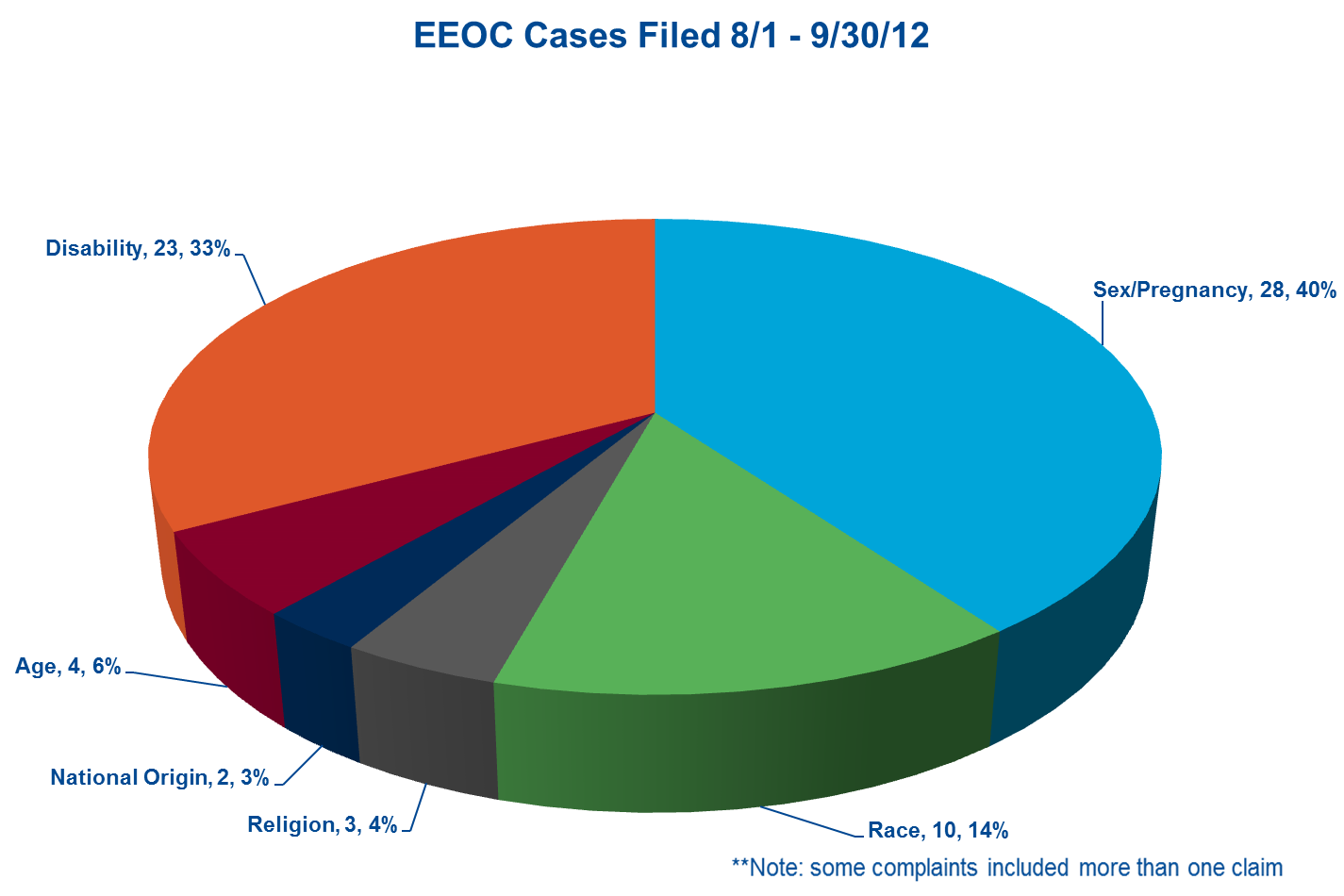
As we have discussed here, the driving force to the EEOC’s future litigation strategy is its Strategic Enforcement Plan. Looking at the EEOC’s FY 2012 filing statistics next to its Draft Strategic Plan provides insight into where the EEOC is headed. For instance, the types of EEOC claims filed in FY 2012 are notable. The EEOC has committed to focus on ADA and pregnancy issues, just to name a couple. A quick review of the EEOC’s FY 2012 filings suggests it has already been ramping up to make good on those committments:                               

         picture 3.png

What does this mean? This fiscal year, the EEOC plans to push for quality over quantity, with a more sniper-like focus on those cases it has already brought. We have already seen an EEOC that is learning how to litigate complex cases smarter and more efficiently. With fewer cases to litigate, and thus more resources to allocate to those matters, we expect the government will be an even more formidable litigation opponent.

What To Expect During FY 2013

The filing arising out of FY 2012 matters may not be over. The EEOC has publically stated that, while it may not have the same year-end push in FY 2012, the agency intended to charge out of the gates in FY 2013. We have seen the EEOC’s warning come to fruition. While the first week of October is usually an almost silent week for the agency, there have already been several fillings in the first week after the close of FY 2012. The EEOC’s path to filing cases during the remainder of FY 2013, however, remains turbulent in light of the upcoming presidential election. Although filing a federal court complaint is relatively inexpensive, staffing and litigating the EEOC’s 122 cases comes at a high price. To that end, President Obama recently signed into law a stop-gap budget to fund the EEOC $360 million – a modest increase over FY 2012 – from October 1st to March 27, 2013, apparently designed to cover the rest of any potential lame-duck presidency. A new administration may spell big changes for the EEOC. Even  post-election priorities of the incumbent administration may still result in budget cuts, or possibly a resource windfall. The EEOC is waiting like the rest of us to see what happens next.

There are more lessons to learn from FY 2012. The EEOC will publish its official filing and charge statistics either this month or early November. Check back in with the Workplace Class Action Blog, as we will provide a more fulsome discussion upon receipt of the EEOC’s numbers. We are also keeping tabs on the EEOC as we wait for its third iteration of the Draft Strategic Plan, which will function as the blueprint for the Commission’s enforcement activity for the next several years. We have blogged about the Draft Plan numerous times (here, here, here, and here) and submitted two letters to the EEOC providing recommendations for ways in which it can better achieve its goals (available here and here). The Commission will likely publish the third draft of the Strategic Plan sometime this month. The significant revisions from first draft to second promises even more surprises in the third sequel to this important strategic plan. Stay tuned.

Readers can also find this post on our EEOC Countdown blog here.

ndohio.jpgBy Rebecca Bjork and Gerald L. Maatman, Jr.

A recent decision underscores how employers facing workplace class actions need to consider all avenues of attack early on to best position themselves to avoid costly discovery and class certification litigation. In Harrison v. The Progressive Corp., et al., No. 1:12 CV 625, 2012 U.S. Dist. LEXIS 136719 (N.D. Ohio Sept. 25, 2012), an argument made by the defense in a Rule 12 motion – which to many might have seemed like a technicality that would go nowhere – but ended up making all the difference in the Court’s decision to eliminate class allegations. 

In Harrison, the named Plaintiff, an African-American man over the age of 40, alleged that he worked in Progressive’s human resources department until 2011. Id. at *2, 4. His First Amended Class and Collective Action Complaint (“FAC”) – which purported to bring a nationwide Rule 23 Title VII class action and ADEA collective action – contended that Progressive “knowingly and intentionally” adopted a company-wide system for evaluating employee performance that it knows, based on internal studies, discriminates against African-Americans, other ethnic groups, and older workers. Id. at *3-4. He brought four causes of action, including disparate treatment and disparate impact discrimination under both Title VII and the ADEA. Id. at *5-7. He sought injunctive relief, in addition to back pay, front pay, compensatory damages, and punitive damages. Id. at 7.

The defendants challenged the class and collective allegations in the FAC under Rule 12, arguing that the face of that pleading itself revealed that a class and collective action had not been properly alleged. Focusing on the Rule 23 requirements, they argued that the named Plaintiff could not adequately represent absent class members due to inherent conflicts within the class; that he did not adequately plead allegations sufficient to satisfy the commonality requirement of Rule 23(a); that Rule 23(b)(2) could not provide a vehicle for his monetary claims; and that the Rule 23(b) predominance requirement could not be met even with discovery on his claims. Id. at *12, n.4. Further, they also independently argued that the class and collective action claims in the FAC were barred due to the fact that the named Plaintiff failed to exhaust his administrative remedies as to those claims by including them in his EEOC charge. Id. at *15. 

Judge Patricia A. Gaughan of the U.S. District Court for the Northern District of Ohio granted the defendants’ motion to dismiss in part. Interestingly, she entirely sidestepped the Rule 23 arguments. Instead, she rested her decision on the fact that the EEOC charge filed by the named Plaintiff, on its face, made allegations about his treatment alone, and therefore did not put Progressive on notice that he would pursue litigation on behalf of a putative class. She explained that “[t]he Sixth Circuit has made clear that class action claims under Title VII and the ADEA are barred where the plaintiff did not express any intent to file class claims in his dealings with the EEOC.” Id. at *15-17 (citing McKnight v Gates, 282 Fed. Appx. 394, 398 (6th Cir. 2008)).  She then examined – and reprinted in full – the charge Mr. Harrison filed with the EEOC,  id. at *18-19, concluding that it was “brought in plaintiffs’ name only and makes no reference whatsoever to any other Progressive employee or similarly-situated individual.” Id. at *21. To make the point crystal clear, she highlighted, in bold face type, the problems she saw with attempting to piggy-back a class action onto such a charge:  “[d]uring my employment . . . I was subject to discriminatory corporate-wide policies, practices, and treatment through which Progressive discriminated against me in all terms and conditions of my employment. . . .”  Id. at 21-22. She rejected the argument that merely by complaining to the EEOC of “discriminatory corporate-wide policies, practices, and treatment,” Harrison had reasonably put Progressive on notice of class action allegations, and/or prompted the EEOC to launch an investigation of class-wide claims of discrimination at the company.  

This ruling demonstrates how it behooves every employer facing a class or collective action lawsuit to focus not only on the adequacy of the Rule 23 allegations in the complaint, but also to pull the charging party’s personnel file and read his or her EEOC charge very, very carefully. The ruling in Harrison undoubtedly will save the employer much heartache and expense in defending the lawsuit.