By Christopher DeGroff, Paul Kehoe and Gerald L. Maatman, Jr.

Employers have become accustomed to the federal courts rubber stamping EEOC subpoenas seeking company-wide information based on a single charge of discrimination. In light of the EEOC’s systemic focus — and the agency’s desire to transform single allegations into a blockbuster systemic actions — aggressive and extensive EEOC subpoenas requests are more and more prevalent, with very little case law authority to cabin the EEOC’s authority. The Court in EEOC v. Forge Industrial Staffing Inc., No. 14-MC-90 (S. D. Ind. Nov. 24, 2014), however, had enough of the EEOC’s strong-arm tactics. In rejecting the Commission’s broad subpoena, Magistrate Judge Mark Dinsmore authored an opinion that provides employers with ammunition to fight “everything and the kitchen sink…” subpoena requests.

Factual Background

In EEOC v. Forge Industrial Staffing Inc., a former employee filed an EEOC charge four months after her termination alleging sexual harassment and retaliation. The Commission sought extensive information from the company as part of its administrative investigation. In its subpoena, the EEOC requested all employment applications for roughly a two and a half year period because the applications purportedly required employees to agree to file all employment-related claims within six months of the event, except as prohibited by law. The EEOC views this provision as an impermissible waiver of an applicant’s statutory rights. The company argued that the requested information was irrelevant to the charge and complying with it would be unduly burdensome.

The Court’s Decision

At the hearing, the EEOC argued that the application waiver related to the “overall conditions of the workplace.” Id. at 5. The Court rejected the EEOC’s position for several reasons. First, the charge did not contain pattern or practice allegations – claims that would suggest a pervasive violation of the law. Second, the charging party filed the charge within four months of the termination, meaning the clause had no impact on her willingness to file a charge. As a result, the waiver could not be relevant to the charge under investigation. The Court recognized that accepting the “overall condition of the workplace” argument would eviscerate the meaning of “relevance” because it would allow the EEOC to subpoena any information about a company at the EEOC’s whim. Id. at 5-6.

Finally, the Court rejected the EEOC’s standard argument that it has a broad mandate to promote the public interest, and therefore, can seek to remedy violations not alleged in a charge. Based on a plain reading of Title VII, which requires relevance to the charge under investigation, the Court reasoned that the EEOC could not expand a single charge into a pattern or practice case with wholly different allegations. The Court noted that the plain language of the statute does not permit an investigation into an violation not alleged in the charge.

Implications For Employers

The ruling in EEOC v. Forge Industrial Staffing Inc. marks the second time in a month that courts have limited the EEOC’s subpoena enforcement authority (see our blog posting here on the recent Eleventh Circuit’s defense ruling on an EEOC subpoena). Although many federal courts continue to grant the EEOC significant deference in subpoena matters, these recent decisions provide a glimmer of hope. Just because the EEOC says information is relevant does not make it so. When confronted with an expanded investigation based on a single charge, without pattern or practice allegations, there is a solid, common sense argument for employers to challenge the subpoena on both relevance and timeliness grounds. Employers should be aware of this and other recent decisions limiting the EEOC’s subpoena authority.

Readers can also find this post on our EEOC Countdown blog here.

By Gerald L. Maatman Jr. and Howard M. Wexler

As we noted in our EEOC Fiscal Year 2014 Scorecard, the EEOC has been steadily increasing its use of its subpoena power to gather as much information as possible from employers prior to filing suit. In fact, in FY 2014, the EEOC prosecuted 24 subpoena actions versus the 17 that were filed in 2013.

FY 2015 has started out with a big win for employers fending off overly broad and unduly burdensome EEOC administrative subpoenas. In EEOC v. Royal Caribbean Cruises, Ltd., No. 13-13519 (11th Cir. Nov. 6, 2014), the Eleventh Circuit Court upheld a decision of the U.S. District Court for the Southern District of Florida refusing to enforce an administrative subpoena served by the EEOC on grounds that the information sought was not relevant to the individual charge the EEOC was investigating and because compliance with the subpoena would be unduly burdensome. Id. at 4.

The Eleventh’s Circuit’s ruling is a big win for employers, and a must read for corporate counsel involved in EEOC litigation.

Background

In 2010 Royal Caribbean discharged an Argentinean national employed as an assistant waiter on one of its cruise ships because he was diagnosed with HIV and Kaposi Sarcoma. Id. at 2. The employee subsequently filed a charge with the EEOC. Id. Royal Caribbean admitted discharging the employee based on his medical condition, but argued both that the Americans With Disabilities Act was inapplicable as the charging party was a foreign national who worked on a ship that operated in the Bahamas and because the Bahamas Maritime Authority’s (“BMA”) medical standards – which Royal Caribbean is required to follow – mandated discharge given the employee’s diagnosis. Id. at 2-3.

During the investigation the EEOC issued an administrative subpoena seeking a list of all employees who were discharged due to a medical reason for the year preceding the filing of the charge along with detailed information for each of these discharged employees, including their personnel files, contact information and information concerning who from Royal Caribbean hired/fire each employee. Id. at 3. The EEOC also requested similar information with respect to any person Royal Caribbean did not hire because of a medical reason. Id. at 4. Both a Magistrate Judge and District Court Judge in the U.S. District Court for the Southern District of Florida refused to enforce the EEOC’s subpoena. Id.

The Eleventh Circuit’s Decision

The Eleventh Circuit’s acknowledged that the EEOC is entitled to inspect and copy any evidence that is “relevant to the charge under investigation,” but it cautioned that such a standard, while broad, should not be construed “so broadly that the relevancy requirement is rendered a nullity.” Id. at 4-5.

The Eleventh Circuit determined that the disputed information at issue did not concern the Charging Party who filed the EEOC charge; instead, it concerned the EEOC’s attempt to discover “a potential class of employee or applicants who suffered from a pattern or practice of discrimination rather than fleshing out [the Charging Party’s] charge.” Id. at 5. While statistical and comparative data in some cases may be relevant, the EEOC is nonetheless required to make “some showing that the requested information bears on the subject matter of the individual complaint.” Id. at 5-6.

The Eleventh Circuit rejected the EEOC’s argument that the requested information “might cast light on the allegations” against Royal Caribbean given that it is not clear “why company-wide data regarding employees and applicants around the world with any medical conditional, including conditions not specifically covered by the BMA medical standards or similar to [Charging Party’s], would shed light on [the Charging Party’s] individual charge that he was fired because of his HIV and Kaposi Sarcoma diagnoses.” Id. at 6.

In arguing that its subpoena should be enforced, the EEOC contended that the information was relevant because “the EEOC is entitled to expand the investigation to uncover other potential violations and victims of discrimination on the basis of disability.”  Id. at 7. The Eleventh Circuit rejected this argument, as it refused to construe the relevancy standard so broadly and because “the relevancy that is necessary to support a subpoena for the investigation of an individual charge is relevant to the contested issues that must be decided to resolve that charge, not relevance to issues that may be contested when and if future charges are brought by other.” Id. at 7 (emphasis added). On this basis the Eleventh Circuit rejected the EEOC’s subpoena as the information sought was “at best tangentially relevant” to the claims of the Charging Party and because it “failed to present a cogent argument as to how the additional information sought…would further aid the Commission in resolving the issues in dispute…” Id. at 9.

The Eleventh Circuit acknowledged that the EEOC has the ability to file a Commissioner’s Charge alleging a pattern or practice of discrimination that could support a request for the broad scope of information that it sought. However, the Eleventh Circuit rejected the EEOC’s apparent attempt to short circuit this process and cautioned the EEOC that it “may not enforce a subpoena in the investigation of an individual charge merely as an expedient bypass of the mechanisms required to file a Commissioner’s charge.” Id.

Finally, the Eleventh Circuit also held that the burden on producing the requested information – which Royal Caribbean estimated would require between five to seven employees working forty hours per week for two months solely to gather the requested information – outweighed the “limited need” of the subpoenaed information. Id. at 10.

Implications For Employers

Case law authority supports the notion that significant deference is accorded the EEOC’s subpoena powers, and the EEOC likes to remind employers of this when it seeks information that goes far beyond the individual charge that it is investigating. However, as this decision highlights, employers caught in the crosshairs of the EEOC’s subpoena enforcement activity are not without recourse. The Eleventh Circuit’s ruling demonstrates that simply because the EEOC says certain information is relevant does not make it so. Employers should keep this decision in their back pocket as ammunition against a runaway EEOC investigation.

Workers can also find this post on our EEOC Countdown blog here.

By Christopher DeGroff and Michael Fleischer

A Win For Transparency

Yesterday, in the U.S. District Court for the District of Massachusetts, the Court turned the tables on the EEOC on a controversial subpoena issue. The EEOC has traditionally used broad subpoenas attempting to extract sensitive and expansive information from employers in cases around the country. (Click here and here to read more.) But here, the EEOC attempted to limit the records the employer could obtain from subpoenas of its own. The Court, however, wouldn’t bite on the EEOC’s argument, and denied the EEOC’s Motion to Quash Chipotle’s subpoenas seeking employment records from claimant’s former and current employers to aid in its defense.

Case Background And Holding

Now for the details: in EEOC v. Chipotle Mexican Grill, Inc., Case No. 1:13-cv-11503-FDS (D.Mass.), the EEOC sued Chipotle on behalf of a former employee alleging that the employee was unlawfully terminated due to her disability. During discovery, Chipotle served several third party subpoenas on the claimant’s other employers seeking her personnel files, wage records, and other records pertaining to her employment (including applications and resumes). Chipotle sought these records in order to defend itself, in part, by demonstrating that the claimant failed to mitigate her damages. Although the EEOC admitted that its claimant’s wage records were relevant to a failure to mitigate defense, and provided the claimant’s W-2s to Chipotle, the EEOC nevertheless insisted that the Court throw out subpoenas as to the claimant’s personnel files, applications, and resumes.

At yesterday’s motion hearing in Boston, the EEOC argued that Chipotle’s subpoenas were overreaching, were not reasonably calculated to lead to the discovery of admissible evidence, and were not necessary for Chipotle’s failure to mitigate defense. Chipotle, on the other hand, stressed that the claimant’s applications and resumes were necessary to support Chipotle’s defense, as the documents would show the claimant’s employment qualifications, efforts to obtain employment, and would be an essential tool for its expert economist to determine what jobs Plaintiff was qualified for and how many of those jobs were available.

Although the EEOC argued that Chipotle could obtain this information during the claimant’s deposition, the Court refused to restrict Chipotle’s access to  only depositions and noted that the Federal Rules of Civil Procedure provided for broad discovery. The Court denied the EEOC’s motion to quash finding that Chipotle’s third party subpoenas for the Plaintiff’s employment records were relevant to Chipotle’s defense but declined to comment on their admissibility.

Implications For Employers

Employers are often frustrated by what they often view as an asymmetric playing field: the EEOC demands to be treated like any other litigant for some issues, but often argues that it should be treated differently (and more favorably) in others because it is a “law enforcement agency.” This case is a quiet but meaningful win for an employer attempting to obtain the same sort of discovery that it would from virtually any other private litigant.  Employers should be encouraged that some jurisdictions like the Court here will rule to keep the playing field even.

Readers can also find this post on our EEOC Countdown blog here.

edpa.gifBy Christopher DeGroff and Gerald L. Maatman, Jr.

It is a common occurrence when litigating against the EEOC to face controversies concerning the scope of discovery in administrative investigations. After all, discovery can help the EEOC put together the building blocks of its case. Increasingly, the Commission resorts to its subpoena power to launch broad-scale discovery in its administrative investigations. That is why defense counsel in EEOC v. Farmer’s Pride, Inc., 12-MC-148 (E.D. Pa. Oct 31, 2012), vehemently opposed the EEOC’s broad discovery requests and challenged the reach of the agency’s subpoena power. 

In EEOC v. Farmer’s Pride, the EEOC’s subpoena sought two broad categories of documents from the Defendant. In a subsequent subpoena enforcement hearing, Judge R. Barclay Surrick, Jr. issued a mixed ruling that upheld the EEOC’s efforts to subpoena an array of information relating to formal or informal complaints of sexual harassment at the Defendant’s facility. As to the employee contact information that the EEOC requested, Judge Surrick issued a confidentiality order that protected the privacy interests of the Defendant’s employees and in no way interfered with the EEOC’s investigation. Judge Surrick also denied the EEOC’s request to put the cost of litigating the subpoena on the Defendant. 

Although this decision is a mixed bag for employers, it provides some ammunition for employers to contain overboard EEOC demands, which is particularly important given the EEOC’s trend to greatly expand the scope of its investigations as part of its Systemic Initiative.

Background Facts

The EEOC’s investigation arose from a charge of discrimination filed by Christian Ramierez on June 20, 2011. Ramierez alleged that the Defendant discriminated against him on the basis of sex and retaliated against him in violation of Title VII. Specifically, he claimed that his female supervisor harassed him and that she also made comments of a sexual nature to other employees. Id. at 2. Ramierez also alleged that two male supervisors acted “inappropriately” towards women employees. Id. 

During its investigation of Ramierez’s charge, the EEOC requested personnel information for all employees supervised by the alleged harassers. The EEOC also requested “[d]ocuments relating to any and all complaints of sexual harassment, whether made formally or informally, since January 2009.” Id. After the Defendant objected to the EEOC’s overbroad requests, the EEOC issued the Defendant a subpoena to produce the requested documents. Although the Defendant complied with some of the EEOC’s requests, the Commission filed an application that sought to enforce all aspects of its subpoena. The Defendant filed an answer to the application and three days later, both parties attended a hearing on the matter. Efforts to resolve the information request failed and the EEOC asked the Court to enter an order directing the Defendant to comply with the subpoena and grant the EEOC costs for enforcing the subpoena. Id. at 5.

The Court’s Ruling

The Court entered an order directing the Defendant to comply with the EEOC’s subpoena. Despite the Defendant’s contention that the EEOC’s request for documents relating to sexual harassment complaints filed at its facility were overbroad, the Court held that it would not limit the EEOC’s subpoena. The Court relied on the decision in EEOC v. Kronos, Inc., 620 F.3d 287 (3d Cir. 2010) (discussed here) for the proposition that the “EEOC’s investigatory power is broad[]. . . and it need not cabin its investigation to a literal reading of the allegations in the charge.” Id. at 8. Additionally, because the Court found that there had been more than one isolated incident of alleged harassment in the Defendant’s facility, it held that documents relating to such claims were “not unreasonable, and not overly broad” even if they were from departments outside of the area where the alleged harassment occurred. Id. at 10-11.

On the bright side for the Defendant, the Court approved its confidentiality order relating to the employee contact information that the EEOC requested. Specifically, the Court prohibited the EEOC from disclosing to Ramierez or his attorney, “the private contact information, namely addresses and phone numbers of all employees” supervised by one of the alleged harasses during his tenure at the Defendant’s company. Id. at 13-14. The Court reasoned that the Defendant met its burden of establishing good cause that disclosure of the employee contact information would create a serious injury. Because the Defendant submitted evidence that Ramierez’s attorney works for an organization that used employee contact information for union organizing, improper solicitation, and bullying tactics in a separate lawsuit, the Court stated that it “understood [the Defendant’s] concern that the personal contact information of its employees could be used for improper purposes.” Id. at 15. Judge Surrick explained that his “concerns were heightened” at the hearing on the EEOC’s application because the hearing in no way lessened “concerns that the personal contact information of [the Defendant’s] employees — most, if not all, of whom have nothing to do with Ramirez’s sexual harassment claim — could be used improperly.” Id. Thus, the Court granted the Defendant’s order to safeguard its interest in maintaining the confidentiality of the Defendant’s employee data.

Implications For Employers  

EEOC v. Farmer’s Pride reaffirms the EEOC’s broad subpoena power. This is of significant importance because as the EEOC continues to initiate systemic investigations, it increasingly issues requests to employers for nationwide data concerning their personnel and employment practices. Judge Surrick’s decision follows EEOC v. Kronos, 620 F.3d 287 (3d Cir. 2010), and limits available arguments against the EEOC’s subpoena power as a means of forcing employers to turn over their data. On the bright side for employers, however, Judge Surrick granted the Defendant’s confidentiality order – which employers are wise to consider when battling EEOC subpoenas.

Readers can also find this post on our EEOC Countdown blog here.

3rd_Circuit_seal.jpgBy Gerald L. Maatman, Jr. and Jennifer Riley

On September 14, 2012, the U.S. Court of Appeals for the Third Circuit issued another opinion in EEOC v. Kronos, Inc., No. 2:09-MC-00079 (3d Cir. Sept. 14, 2012) (“Kronos II”), addressing an ongoing controversy concerning the scope of the EEOC’s subpoena power. (Click here for our previous post on this issue.) 

As the EEOC continues to ratchet up its systemic investigations, it increasingly issues requests to employers for nationwide data concerning their personnel and employment practices, and increasingly the Commission has resorted to its subpoena power to force employers to turn over their data. Third parties are not immune from these efforts.   

In a case of significant importance, the Third Circuit weighed in for a second time in Kronos II on the EEOC’s attempt to obtain broad discovery from a third party. In a mixed opinion, the Third Circuit upheld the EEOC’s efforts to subpoena a broad array of information and refused to cabin the EEOC’s use of such information to the operative administrative charge. 

On the bright side for employers, however, the Court approved broad confidentiality protections and an order directing the EEOC to share the cost of complying with its requests.  

Background

The EEOC’s investigation arose from a charge of discrimination filed by Vicky Sandy with the EEOC on June 30, 2007. Sandy, who is hearing and speech impaired, applied to work as a cashier, bagger, and stocker at a Kroger grocery store in West Virginia. As part of the application process, Sandy took a Customer Service Assessment test created by Kronos. Sandy received a score of 40%, and Kroger relied, at least in part, on the test when it decided to reject Sandy’s application. 

The Ruing In Kronos I

During its investigation of Sandy’s charge, the EEOC issued a third-party administrative subpoena to Kronos. The EEOC sought information regarding the nationwide use of Kronos’ assessment tests and information regarding their impact on both minority and disabled applicants. See EEOC v. Kronos, Inc., 620 F.3d 287, 294 (3d Cir. 2010) (“Kronos I”). After Kronos objected, the EEOC filed a motion to enforce the subpoena in the district court. 

The district court limited the scope of the subpoena to documents related to Kroger’s West Virginia operations, and the positions at issue, from January 1, 2006 to May 31, 2007, and refused to allow discovery related to racial discrimination. Id. at 295. 

The Third Circuit reversed the district court’s geographical, temporal, and position-related limitations, but agreed that the EEOC’s request for documents related to adverse impact on the basis of race was improper because Sandy alleged only disability discrimination. Id. at 301. The Third Circuit also vacated the confidentiality order entered by the district court and remanded for the district court to conduct a “good cause balancing test.” Id. at 301-02.

The Ruling In Kronos II

On remand, the district court entered an order directing Kronos to comply with a modified subpoena. Among other things, the district court limited production of nationwide data to studies or evidence that “were relied upon in creating or implementing the test for Kroger” and information that related to “disabilities, persons with disabilities, or adverse impact upon persons with disabilities.” Kronos II, at 11. It also entered a modified confidentiality order and a cost-sharing order that directed the EEOC to reimburse Kronos for 50% of the estimated $75,000 cost of complying with the subpoena. The EEOC subsequently appealed.

In Kronos II, the Third Circuit again rejected the limitations imposed by the district court. The Third Circuit held that documents discussing any potential adverse impact were relevant – even if not connected to Kroger –  because they could assist the EEOC in evaluating whether Kroger’s use of the test constituted an unlawful employment action. Id. at 17.  

The Third Circuit also held that communications between Kroger and Kronos regarding the test — or any other tests purchased by Kroger — were relevant even though they might not directly relate to any applicant’s disabilities. Id. at 20. The Court noted that, even though the EEOC could not target documents related to race, if the documents happened to reveal a racially-related impact, the EEOC need not ignore such evidence. Id. at 21.

The Third Circuit also upheld the district court’s decision to enter a confidentiality order, noting that the EEOC’s interest in information-sharing could not outweigh the tremendous harm to Kronos that could result from the disclosure of Kronos’ proprietary information. Id. at 26. The Court of Appeals, however, modified the order to remove any presumption that information disclosed by Kronos automatically would be exempt under FOIA, and it also removed any limitation on the EEOC’s use of the data disclosed by Kronos. Id. at 27-29. It reasoned that “once we have decided the documents sought are relevant to the charge of discrimination, any other improper behavior discovered during the course of the EEOC’s investigation may be pursed.” Id. at 29.

Finally, the Third Circuit upheld the district court’s order requiring the EEOC to reimburse Kronos for half the cost of producing the subpoenaed information. The Court of Appeals recognized that such a cost-sharing order was within the district court’s discretion and noted that, because its order likely would lead to additional costs, the district court could reconsider the allocation upon remand. Id. at 32-33. 

Implications

Kronos II is a mixed bag for employers and those unfortunate enough to be dragged into systemic investigations by the EEOC. Most notably, the Third Circuit reaffirmed the EEOC’s broad subpoena power and refused to limit Kronos’ production to information concerning the target of the investigation. On the upside for employers, however, the Third Circuit approved the bulk of the district court’s confidentiality order, as well as a cost-sharing plan that could shift upwards of $40,000 to the EEOC. While a bright spot, the Third Circuit noted Kronos’ “non-party” status, and it remains to be seen whether the courtesy of cost-sharing will be extended to others.

Readers can also find this post on our new EEOC Countdown blog here.

250px-US-CourtOfAppeals-10thCircuit-Seal.pngBy Christopher DeGroff and Matthew Gagnon

Rulings over EEOC administrative enforcement subpoenas are increasing. It’s a manifestation of the EEOC’s aggressive strategy in expanding systemic investigations, and of employers resisting those efforts.

On February 27, the U.S. Court of Appeals for the Tenth Circuit upheld a District Court’s refusal to enforce an overly broad administrative subpoena issued by the EEOC. EEOC v. Burlington N. Santa Fe Ry. Co., Case No. 11-1121 (10th Cir. Feb. 27, 2012). The case involved two charges asserting Americans With Disabilities Act (“ADA”) claims by individuals in Colorado against Burlington Northern Santa Fe Railway Co. (“BNSF”) after they were rejected for employment based on a medical examination. Id. at 2.

The EEOC v. Burlington N. Santa Fe Ry. Co. ruling is noteworthy for its rejection of the EEOC’s strategy.

Factual Background

On February 2, 2009, the EEOC sent a request for information to BNSF for “any computerized or machine-readable files . . . created or maintained by you . . . during the period December 1, 2006 through the present that contain electronic data about or effecting current and/or former employees . . . throughout the United States.” Id. at 2-3. BNSF challenged the scope of the documents requested by the EEOC, and sought documentation from the EEOC to support the EEOC’s investigation beyond the incidents involving the two individuals who filed the ADA charges. Id. at 3. Instead of providing that information, the EEOC instead served a subpoena on BNSF demanding the information requested in the letter.  BNSF contested the subpoena and refused to comply with it. Id. The EEOC then applied to the District Court to enforce the subpoena. The Tenth Circuit refused to do so. Id. at 3-4.

The Tenth Circuit’s Decision

The Tenth Circuit held that the District Court did not abuse its discretion in refusing to enforce the EEOC’s subpoena. The statute that grants the EEOC the authority to issue administrative subpoenas states that the EEOC may access “any evidence of any person being investigated” so long as that evidence “relates to unlawful employment practices . . . and is relevant to the charge under investigation.” Id. at 5 (quoting 42 U.S.C. § 2000e-8(a)). Although the Court noted that the relevancy requirement was not particularly restrictive, it upheld the District Court’s determination that the subpoena was not relevant to the two charges pending against BNSF. Id. at 5.

The EEOC pointed to four other complaints filed against BNSF in other states making similar allegations of discrimination, and argued that it was entitled to nationwide discovery because it was investigating a pattern or practice of discrimination carried out on a nationwide basis. Id. at 4-5. The Tenth Circuit rejected the EEOC’s argument by noting that there was no reference to any of the four additional charges in the EEOC’s subpoena. Id. at 6. The cover letter to the subpoena only stated that the requested information was related to pattern or practice discrimination, and that the EEOC was broadening its investigation “under the authority granted by the statute.” Id. The Tenth Circuit held that this statement “does not identify the statute to which it refers, it does not constitute a ‘charge’ of discrimination, and it conveys no basis for expanding the investigation.” Id. Accordingly, the only charges under investigation were those filed by the two individuals, and the EEOC only had power to issue a subpoena for information relevant to those charges. The Tenth Circuit concluded that nationwide record-keeping data was not relevant to individual charges of discrimination filed by two men who applied for the same type of job in the same state. Id. at 9-10.

The Tenth Circuit also rejected the EEOC’s attempts to justify the breadth of its request. The EEOC had contended that the two charges of discrimination would be a part of any pattern or practice of disability discrimination at BNSF, if such a pattern or practice existed. Id. at 7. The Tenth Circuit reasoned that this threatened to undermine the relevancy requirement of the EEOC’s subpoena power, since any act of discrimination could always be a part of a pattern or practice of discrimination. Id. Critically, the Tenth Circuit opined that not every charge of discrimination warrants a pattern or practice investigation. Id.

Key Observations In The Ruling

The Tenth Circuit made two observations of special interest to employers that frequently deal with the EEOC.

First, it noted that BNSF was likely aware of the other charges that had been filed against it because the EEOC is required to send an employer notice of any such charge within ten days of receiving it. Id. at 6 n.2. However, this could not excuse the EEOC’s refusal to inform BNSF of which other charges the EEOC was considering as additional support for a nationwide investigation.  Id.

Second, the Tenth Circuit distinguished a Seventh Circuit case – EEOC v. Konica Minolta Bus. Solutions U.S.A., Inc., 639 F.3d 366 (7th Cir. 2011) – on the basis that disability discrimination is different from racial discrimination. In that case, the Seventh Circuit upheld an EEOC subpoena based on an individual allegation of racial discrimination. The Tenth Circuit reasoned that racial discrimination is by definition class discrimination; although it may have been appropriate to allow such an investigation based on one complaint of racial discrimination, the same could not be said of individual complaints of disability discrimination. Id. at 9.

Key Take-Aways For Employers

Employers should expect that the EEOC will take the dicta about the distinction between race and ADA charges as a way to cabin the Tenth Circuit’s reasoning. Nonetheless, the ruling in EEOC v. BNSF is a handy piece of ammunition for employers facing broad information requests in investigation of ADA claims.

seal.pngBy Christopher DeGroff and Gerald L. Maatman, Jr.

The EEOC routinely claims that its subpoena power is extremely broad and vigorously resists any attempt to reign in that power. Some Courts share that belief, and have allowed the EEOC to cast a broad net for information, even when the charge allegations that the government is investigating are narrow. Our previous posts have noted that trend.

In EEOC v. Loyola University Medical Center, Case No. 11-CV-4456 (N.D. Ill. Oct. 13, 2011), however, Judge Charles Kocoras of the U.S. District Court for the Northern District of Illinois took a hard line with the EEOC, limiting the amount of information it could obtain via a subpoena stemming from an administrative investigation. The ruling is well worth a read by corporate counsel and HR professionals who deal with EEOC investigations.

The charging party in the EEOC v. Loyola case alleged that Loyola discriminated against her based on disability when it required her to submit to a fitness for duty examination (“FDE”) consisting of a blood test, a breath alcohol test, and a medical exam. The EEOC sent Loyola a request for information as part of its administrative investigation, asking Loyola to divulge information relative to other employees who were ordered to take FDEs and the results and reasons for those examinations. Loyola partially responded to that request, noting that only one employee had been required to submit to an FDE for the supervisors specified by the EEOC’s information request. Not content with that answer, the EEOC issued a subpoena, expanding its demand for information to all employees subjected to an FDE during the relevant time period, and in so doing sought very sensitive details of those examinations.

Applicable EEOC regulations – 29 C.F.R. Sec. 1601.16 – require an employer to assert any objections to a subpoena within five (5) days. Loyola did not do so. Almost a month after the EEOC served its subpoena, Loyola wrote a letter to the government saying that it could not provide the requested information because it would violate federal and state medical confidentiality laws. Loyola did not file a petition to revoke the subpoena before sending its letter. The EEOC later filed a subpoena enforcement action, and the matter was assigned to Judge Kocoras.

This case involved some thorny procedural and substantive issues. The first item the Court tackled was a procedural issue that has historically worked against employers when addressing a subpoena. An employer seeking to revoke or modify a subpoena must do so within five days of its receipt. This is an extremely tight deadline for unwary employers, and missing this procedural step arguably waives all of a company’s objections – and the EEOC always argues waiver when an employer does not assert objections within the five day period. In this case, Loyola did not respond to the EEOC until weeks after the fact, nor did it actually file a petition, but instead sent only a letter to the EEOC. The EEOC claimed that Loyola’s procedural miscues meant that it waived any objections to the subpoena. Loyola responded with the argument that only patients can waive their confidentiality rights, regardless of the EEOC’s procedural arguments. The Court sided with Loyola, noting that there is no Seventh Circuit opinion that has held that it was bound by the EEOC regulations to ignore the merits of a subpoena challenge, and thus held that it would not ignore Loyola’s arguments. Id. at 5-6. 

Judge Kocoras then dug into the substance of Loyola’s argument by focusing on the relevance of the information the EEOC was seeking to the underlying charge.  The Court recognized that the EEOC’s subpoena powers are broad, but not unlimited. Id. at 4. The Court reasoned that granting too much authority to the EEOC that the relevance requirement “becomes a nullity.” Id. at 6-7. The Court reasoned that this case focused on whether Loyola’s FDE was job related. The medical records of other employees, Judge Kocoras determined, “shed no light whatsoever” on whether the FDE in this matter was job related to the charging party’s position. Id. at 7. Even under a broad reading of the EEOC’s subpoena power, the subpoena remained unenforceable because it was “not sufficiently tailored to the particular circumstances of the investigation.” Id. at 8. The EEOC’s request for all employee medical data – when the charge related to only one employee – was just too broad. Interestingly, the Court came to that conclusion without even addressing the question of whether the information sought was protected by confidentiality laws. Id at 9. 

The EEOC v. Loyola decision represents a small but increasingly important line of cases that have limited the EEOC’s authority to enforce overbroad subpoenas. That Judge Kocoras was willing to disregard the EEOC’s procedural regulations is also significant. The EEOC often cites to those regulations as controlling in all jurisdictions and forums, but as Judge Kocoras noted, there is no authority in the Seventh Circuit that prevented him from hearing the merits of the employer’s position, procedural challenges notwithstanding. 

Co-authored by Christopher J. DeGroff  and  Laura J. Maechtlen

On November 4, 2010, Judge Elaine Bucklo of the U.S. District Court for the Northern District of Illinois ordered Kable News Company to respond to a wide ranging EEOC subpoena over stiff resistance by the Company, view ruling.  The EEOC sought nearly three years of detailed, Company-wide employee data to investigate a single former employee’s age claim.  Kable News first objected that the subpoena was overbroad and sought information irrelevant to the employee’s claim.  The Court rejected the argument, citing the extremely broad latitude the EEOC was arguably afforded when investigating age claims.  Kable News also complained that the subpoena represented too much of a burden, and responding to the subpoena would monopolize its HR staff for as much as three months.  The Court rebuffed these arguments as well, expressing skepticism that this would pose such a significant burden on a large corporate employer, View Docket Entry.

With the sharp rise in EEOC subpoena enforcement actions, employers must pick their arguments wisely.  Relevance is a difficult argument, particularly in age claims, and arguing that responding to a subpoena would be unduly burdensome must be backed up by compelling and detailed arguments, particularly when made by a large corporate employer.

The EEOC is ratcheting up its systemic investigations like never before. Employers are increasingly facing nationwide requests for personnel data and company-wide investigations of their personnel practices. The EEOC is also resorting to its subpoena power to force employers to turn over their HRIS data. In a case of significant importance rendered on September 7, the Third Circuit in EEOC v. Kronos, Inc. narrowed an EEOC’s third-party administrative subpoena and adopted the defendant’s broad confidentiality proposal. The Third Circuit overturned part of the decision, affirmed part of it, and remanded the confidentiality issue back for further deliberations.


The case arose out of a disability discrimination claim by Vicky Sandy, who is hearing and speech impaired. She applied for a job as a cashier, bagger, and stocker with Kroger Food Stores and was not hired. Kroger utilized a test created by Kronos in determining whether or not to hire Ms. Sandy. It was this test and its possible disparate impact that became the focus of the EEOC’s investigation. The EEOC sought information on the use of the test in hiring from Kronos through a third-party subpoena. The EEOC also expanded its investigation to include race discrimination, even though Ms. Sandy’s complaint had not alleged race discrimination.

The Third Circuit allowed the EEOC’s administrative subpoena requesting information about the test used by Kroger as it related to the claim of disability discrimination. However, it rejected the EEOC’s request for information regarding the test as it related to a race discrimination claim. The Third Circuit reasoned that “[w]e conclude that the inquiry into potential race discrimination is not a reasonable expansion of Sandy’s charge. Instead, the EEOC’s subpoena for materials related to race constitutes an impermissible ‘fishing expedition.’” The Third Circuit also vacated the District Court’s confidentiality order and remanded the issue so that the District Court could conduct a “good faith balancing test” before reissuing a new order.

EEOC v. Kronos, Inc. is fertile source for employers seeking to narrow and opposed unreasonable request for information from the EEOC. We expect the decision to received significant citation in employer briefs challenging the EEOC’s discovery requests and subpoenas in systemic investigations.

By: Gerald L. Maatman, Jr.Christopher J. DeGroff, Matthew J. Gagnon, and Alex W. Karasik

Seyfarth Synopsis: Following the EEOC’s down 2020 fiscal year, in which the Commission made significant changes to many of its programs in the midst of the global COVID-19 pandemic and leadership changes, in FY 2021 the EEOC’s litigation enforcement activity showed signs of recovering from the lingering pandemic. The number of cases filed by the EEOC increased in a respectable climb back to pre-pandemic levels, forecasting a busy year ahead for the Commission and employers in FY 2022.

For the most of the last 25 years, the EEOC’s Fiscal Year ended with a surge in last-minute lawsuits. August and September filings often eclipsed the entire rest of the year combined.  Following a “down year” in FY 2020 where only 33 lawsuits were filed in September, the finish in FY 2021 represented a return to form, with 59 lawsuits filed during September (similar to the 52 filed in September of FY 2019, and 84 in FY 2018). At the time of publication of this blog posting, the EEOC filed 114 total cases in FY 2021, which includes 111 merits lawsuits and 3 subpoena enforcement actions. This total number of filings is more than last year’s total of 101 lawsuits (see here), but still less than the last two years prior (see here and here).

Cases Filed By EEOC District Offices

In addition to tracking the total number of filings, we closely monitor which of the EEOC’s 15 district offices are most actively filing new cases. Some districts tend to be more aggressive than others, and some focus on different case filing priorities. The following chart shows the number of lawsuit filings by EEOC district office.

The most noticeable trend of FY 2021 is the filing dip in some key regions compared to past years. The New York district office fell from 12 filings in FY 2020 to 6 filings in FY 2021. The California district offices in San Francisco and Los Angeles, which combined for 16 new filings last year, declined in FY 2021, coming at a combined total of 13 new filings, including San Francisco’s fall from 10 to 6. The Indianapolis district office, which had a huge year in FY 2020 with a nation-leading 13 filings, returned to the middle of the pack with only 4 filings this year.

On the other hand, leading the pack in new filings was the Philadelphia district office with 14 filings. Chicago’s filings shot up from 3 filings last year to 9 filings this year, and the Dallas district office made a similarly large jump from 5 filings from FY 2020 to 11 filings in FY 2021. The Birmingham district office also made a noticeable move from 5 filings in FY 2020 to 9 filings in FY 2021. Overall, following a substantial decline in litigation enforcement activity in FY 2020, the increase filings in FY 2021 suggests the EEOC is back on track at most of its regional offices across the country.

Analysis Of The Types Of Lawsuits Filed In FY 2021

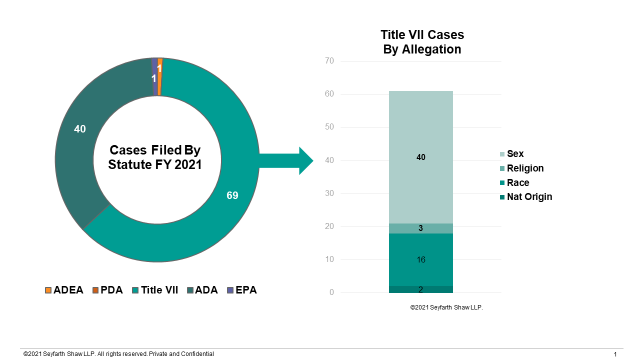
Each fiscal year we also analyze the types of lawsuits the EEOC files, in terms of the statutes and theories of discrimination alleged, in order to determine how the EEOC is shifting its strategic priorities. Those numbers at least – when considered on a percentage basis – are in line with the numbers we have seen the last few years. The graphs below show the number of lawsuits filed according to the statute under which they were filed (Title VII, Americans With Disabilities Act, Pregnancy Discrimination Act, Equal Pay Act, and Age Discrimination in Employment Act) and, for Title VII cases, the theory of discrimination alleged.

When considered on a percentage basis, the distribution of cases filed by statute remained roughly consistent compared to FY 2020 and 2019. Title VII cases once again made up the majority of cases filed, making up 62% of all filings (on par with the 60% in FY 2020 and 60% in FY 2010). ADA cases also made up a significant percentage of the EEOC’s filings, totaling 36% this year, a moderate uptick from 30% in FY 2020. There was only one age discrimination case filed in FY 2021, down seven from FY 2020.

February 2021 Release Of Enforcement Statistics

On February 26, 2021, the EEOC released its comprehensive enforcement and litigation statistics for FY 2020 (available here). The dip in the number of charges that employers saw in 2018 and 2019 continued through 2020, with the number of charges reaching its lowest point since 1997. The prominence of gender discrimination charges seen in 2018 due to the #MeToo movement has all but disappeared, with sex discrimination charges remaining in the fourth-place position and dropping to their lowest number in over 20 years. When the FY 2021 figures are released in the coming months, we do not expect there to be much departure from this trend.

However, monetary benefits recovered by the Commission in FY 2020 surged. The EEOC recovered a record amount of $535.4 million on behalf of alleged discrimination victims. By comparison, the EEOC recovered approximately $486 million in FY 2019; approximately $505 million in FY 2018; and approximately $484 million in FY 2017.  When the final figures are released for FY 2021, we anticipate there will be a similar eye-popping dollar amount of recoveries.

January 2021 Release Of Annual Performance Report

On January 19, 2021, the EEOC released its second-ever Annual Performance Report (“APR”) for FY 2020 (see here). In essence, it is a report card on the Commission’s activities, including its record relative to enforcement litigation. That said, the APR is an analysis of the EEOC’s litigation goals and performance results, and contains important data points regarding the EEOC’s changing strategic objectives and potential future targets of heightened enforcement activity.

In what can be considered a potential explanation for the decline in lawsuits, during FY 2020, the Commission conducted 6,272 mediations, resulting in $156.6 million in relief to charging parties. Further, 766 federal sector mediations were conducted, reducing the inventory of federal sector disputes. Overall, approximately $333.2 million in relief was recovered through mediation, conciliation, and settlements.

When this data is later released for FY2021, given the shutdowns in the courts coupled with the surge of virtual mediations, we anticipate the number of mediations and recoveries will remain significant.

Implications For Employers

FY 2020 was a year of whirlwind change at the EEOC as a result of the pandemic and leadership changes, and the FY 2021 aftermath resulted in strikingly similar results. Now that the new leadership regime and their structural changes are finally settling in to a world that remains hampered by a lingering global pandemic, employers find themselves once again looking out over an uncertain future of the employment landscape. It remains to be seen how new priorities and strategies will impact their businesses in FY 2022, especially when many businesses are shifting to remote work structures that may limit some of the common catalysts of workplace discrimination.

We will continue to monitor these changes closely and keep readers apprised of developments. Our annual comprehensive analysis of trends in EEOC litigation will be published at the end of the calendar year. As always, we will keep abreast of EEOC data amid the ever-changing political milieu, and share lessons learned from FY 2021 to carry employers through the new year.

Readers can also find this post on our EEOC Countdown blog here.